
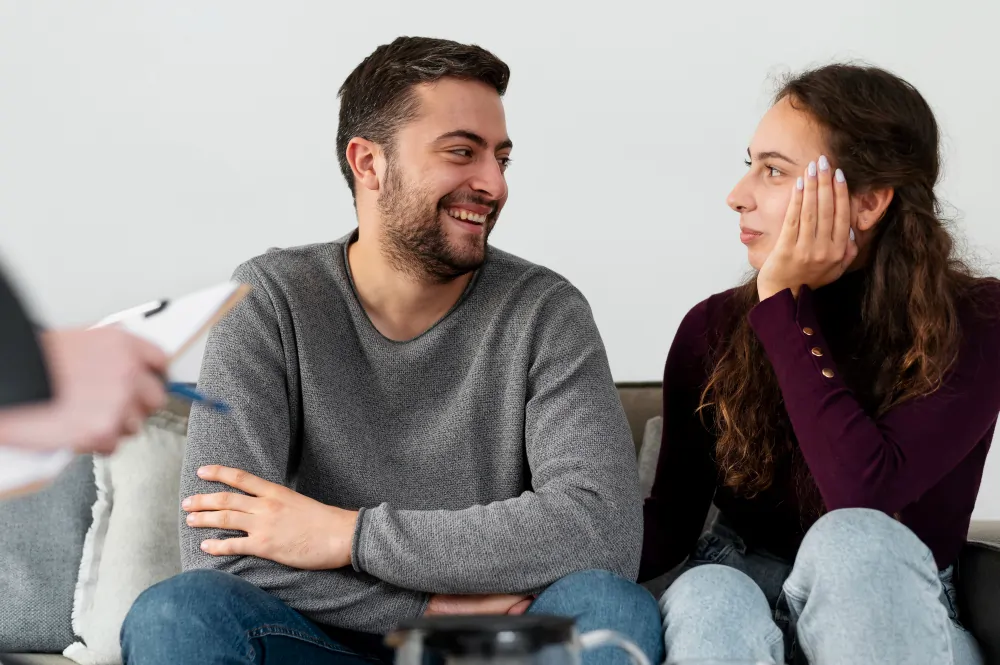
Couples rarely walk into my London consulting room because everything is fine. They come because the same argument keeps looping, trust has been bruised, or intimacy has quietly slipped away. The first thing I want them to know is that relationship therapy works; not only as a last resort before separation, but as a structured, evidence-based way to repair communication, de-escalate conflict, rebuild trust, and restore emotional and physical connection.
UK bodies including the BACP and therapists such as Tavistock Relationships recognise couples counselling as effective at any stage, not only during acute crisis. Outcome studies report that around 70% of couples see measurable improvement in relationship satisfaction after a structured course of treatment (Lebow et al., 2012; Snyder & Halford, 2012). Below is an honest account of the nine outcomes I see most reliably in clinical practice, and the ones the usual benefits lists oversell.
What is relationship therapy?
Relationship therapy, also called couples therapy, couples counselling, or relational psychotherapy, is a clinical intervention in which both partners attend sessions together with a qualified therapist, typically UKCP-registered, BACP-accredited, or Tavistock-trained. Sessions usually run weekly or fortnightly for 50 minutes, in person or online, and draw on evidence-based models including Emotionally Focused Therapy (EFT), the Gottman Method, Integrative Behavioural Couple Therapy (IBCT), or psychodynamic couple work. The relationship itself is the client; the therapist’s role is to make the interaction pattern visible so both partners can change it.
What are the 9 evidence-based benefits of therapy in relationships?
In a 12 to 20 session course of work, some of the most common outcomes include the following:
1. Improved communication
In couples therapy, partners replace criticism, defensiveness, contempt, and stonewalling, or Gottman’s “Four Horsemen”, with active listening, soft start-ups, and clear “I” statements.
2. Constructive conflict resolution
Therapy gives couples permission to reframe disagreement as information rather than a perceived threat, providing partners with a shared repertoire of repair attempts and de-escalation techniques.
3. Rebuild trust after rupture
Structured trust-repair protocols (such as Gottman’s atonement, attunement, and attachment sequence) provide couples with a clear path back to security after infidelity, financial dishonesty, or chronic emotional unavailability.
4. Deeper emotional and physical intimacy
Emotionally focused therapy, or EFT, targets the negative interaction cycle that blocks intimacy in particular. Once interrupted, vulnerability, affection, and sexual connection typically return without needing to be forced.
5. Identification of negative patterns
Couples often aren’t fighting about what they think they’re fighting about. Therapy surfaces the underlying attachment fears, such as abandonment or engulfment, which drive the surface conflict.
6. Facilitating smoother life transitions
Whether parenthood, blended families, retirement, a partner’s career change, fertility journeys, or bereavement, therapy provides a structured place to renegotiate roles before resentment sets in.
7. Better individual mental health
Couples work has documented spill-over benefits for depression, anxiety, and PTSD in each partner (Baucom et al., 2014).
8. Greater self-awareness
Each partner gains a clearer view of their own attachment style, triggers, and inherited family-of-origin patterns.
9. Clarity about the future
Therapy supports a couple to either recommit, or to separate with dignity. Both outcomes replace ambiguity with informed choice.
What changes before and after relationship therapy?
The shift is rarely about fewer disagreements; it’s about how disagreements are handled.
| Dynamic | Before therapy | After therapy |
| Communication | Interrupting, defensive, silent, contemptuous | Active listening, soft start-ups, clear requests |
| Perspective-taking | “I’m right, you’re the problem” | Empathic curiosity about the partner’s inner world |
| Conflict pattern | Repetitive, escalatory, unresolved | Constructive negotiation with repair attempts |
| Emotional climate | Distant, roommate-like, or volatile | Secure attachment, affection, mutual respect |
| Trust | Hyper-vigilance or avoidance | Reliable, repairable, boundaried |
| Intimacy | Avoided, transactional, or absent | Wanted, mutual, emotionally connected |
When should couples start therapy?
Earlier than most do. Gottman Institute research suggests the average couple waits six years between the onset of serious distress and seeking help, by which point contempt has often calcified. Book an initial consultation if you’re stuck in a recurring argument, sex or affection has dropped off, secrets are creeping in, you’re navigating a major transition (parenthood, IVF, redundancy, bereavement), you’re considering marriage and want to pressure-test the foundations, trust has been broken, or you’re contemplating separation but want a clear-eyed decision.
What therapeutic approaches actually work for relationships?
UK-trained therapists typically draw on one or more of the following approaches:
Emotionally Focused Therapy (EFT)
EFT is an attachment-based form of therapy primarily tailored to couples, developed by Dr Sue Johnson. It is designed to foster secure emotional bonds by identifying and transforming negative interaction cycles into positive, safe connections. Around 70 to 75% of couples move from distress towards recovery; ~90% show significant improvement (Johnson, 2019).
The Gottman Method
The Gottman Method was developed by Dr. John and Julie Gottman, and is built on 40+ years of longitudinal research with over 3,000 couples. It focuses on the Sound Relationship House (building love maps, sharing fondness and admiration, turning towards each other) and the Four Horsemen (four toxic communication styles to avoid; criticism, contempt, defensiveness and stonewalling, which lead to relationship failure).
Integrative Behavioural Couple Therapy (IBCT)
IBCT is an evidence-based therapy for couples developed by Dr. Andrew Christensen and Dr. Neil Jacobson (Christensen & Doss, 2017). It combines acceptance work with behavioural change, and has a strong evidence base.
Psychodynamic couple therapy
Psychodynamic couple therapy is an in-depth psychological treatment for couples, based upon the application of psychoanalytic theory (Scharff and Scharff, 2014). It focuses on the underlying unconscious conflicts as well as past experiences and emotional patterns which drive current relational issues.
Cognitive Behavioural Couple Therapy (CBCT)
CBCT targets the thoughts and behaviours maintaining negative cycles.
Does couples therapy work? What does the UK evidence say?
Yes, with clinically meaningful effect sizes. Lebow et al. (2012) found moderate-to-large positive effects on relationship satisfaction, typically maintained at follow-up. NICE recommends couple-based interventions for depression where relationship distress is a contributing factor. Outcomes are best when both partners attend willingly (not under ultimatum), the work begins before contempt has entrenched, and the therapist holds accreditation with the UKCP, BACP, BPC, or an equivalent accreditation body.
What happens in my first relationship therapy session?
The first couples session I offer at Kind Soul Psych in couples therapy is generally 90 minutes’ long and covers three things. This includes a shared history of the relationship, each partner’s hopes for the work, and the presenting concerns. I’ll offer an early formulation, or working hypothesis about the cycle you’re caught in, and we’ll agree session frequency and a tentative course length. You don’t need to arrive with a clean narrative; half-thoughts and contradictions are useful raw material for us to begin with in couples counselling.
Ready to start?
If any of this resonates with you, the next step is a free 20-minute discovery call. We’ll talk through what’s happening, whether couples work is right for you, and what a realistic course of treatment would look like.
Frequently Asked Questions
Is couples therapy worth it?
Yes, for the majority of couples who attend together willingly. Roughly 70% report measurable improvement in relationship satisfaction, and gains typically hold at follow-up (Lebow et al., 2012). It’s most cost-effective started early, before contempt has entrenched, and least effective when one partner has already decided to leave.
How long does couples therapy take?
Most courses run 12 to 20 weekly or fortnightly sessions. Communication and conflict patterns often shift within the first 6 to 8. Trust repair after infidelity or longer-standing distress generally takes 20 sessions or more. I review progress with couples every 6 sessions so the work has a clear endpoint, not an open-ended commitment.
Can couples therapy work if only one partner wants it?
It can. However, the more effective route is usually individual relational therapy for the willing partner first, which often shifts the dynamic enough that the reluctant partner agrees to join later. Couples work imposed under ultimatum rarely succeeds; both partners need at least minimal openness for the cycle to change.
Is online couples therapy as effective as in-person?
For most couples, yes. Recent UK and international studies show comparable outcomes for online and in-person couples therapy on relationship satisfaction and communication measures. Online is often the better choice when partners live apart, travel for work, are caring for young children, or simply find it easier to be honest from their own sofa. If you’d like to know more, please read my guide to online couples therapy.
How much does relationship therapy cost in London?
Private couples therapy in London typically ranges from £90 to £180 per 50-minute session, depending on the therapist’s qualifications and location; UKCP- or BACP-trained clinicians sit toward the upper end. Some practitioners offer reduced fees for trainee-supervised work or sliding-scale arrangements; ask during your initial enquiry.
References
- Baucom, D. H., Whisman, M. A., & Paprocki, C. (2014). Couple-based interventions for psychopathology. Journal of Family Therapy, 34(3), 250–270.
- Christensen, A., & Doss, B. D. (2017). Integrative Behavioral Couple Therapy. Current opinion in psychology, 13, 111–114.
- Johnson, S. M. (2019). Attachment Theory in Practice: EFT with Individuals, Couples, and Families. Guilford Press.
- Lebow, J. L., Chambers, A. L., Christensen, A., & Johnson, S. M. (2012). Research on the treatment of couple distress. Journal of Marital and Family Therapy, 38(1), 145–168.
- Scharff, D. E., & Scharff, J. S. (2014). An overview of psychodynamic couple therapy. In D. E. Scharff, J. S. Scharff (Eds.) & D. Hewison, C. Buss-Twachtmann, J. Wanlass (Collaborators), Psychoanalytic couple therapy: Foundations of theory and practice (pp. 3–24). Karnac Books.
- Snyder, D. K., & Halford, W. K. (2012). Evidence-based couple therapy. Journal of Family Therapy, 34(3), 229–249.